Yes, Your Parents Can Pay Your FHA Down Payment and Here's How
- Jordan Vreeland

- Mar 14
- 4 min read
If a family member wants to help with your down payment, an FHA loan is one of the few loan programs that genuinely welcomes it. You can use 100% of your down payment from gift funds on an FHA loan, provided the gift comes from an eligible source and is documented the right way. That last part is where buyers run into problems.

Here's how gift funds work with FHA loans, what the documentation requirements actually look like, and what to avoid if you don't want the underwriter sending your file back for more paperwork.
What Counts as a Gift Fund for FHA?
FHA guidelines allow gift funds from a fairly wide circle. Eligible sources include family members (parents, siblings, grandparents, aunts, uncles, and spouses), close friends with a "clearly defined interest" in the borrower, labor unions, employers, and charitable organizations. The government itself can also be a source if it's an approved down payment assistance program.
What's not allowed? Gifts from anyone with a financial interest in the sale. That means the seller, the builder, the listing agent, and the lender can't gift you money toward a down payment. If any of those parties put money in, it gets treated as a sales concession and subtracted from the purchase price.
How Much of the Down Payment Can Be a Gift?
On an FHA loan, the entire down payment can be a gift. There's no requirement that any portion of the down payment come from your own funds as long as the property is a primary residence and the gift comes from an eligible source.
This is different from conventional loans, which often require the borrower to contribute at least part of the down payment depending on the loan-to-value ratio and loan size.
The Gift Letter Requirement
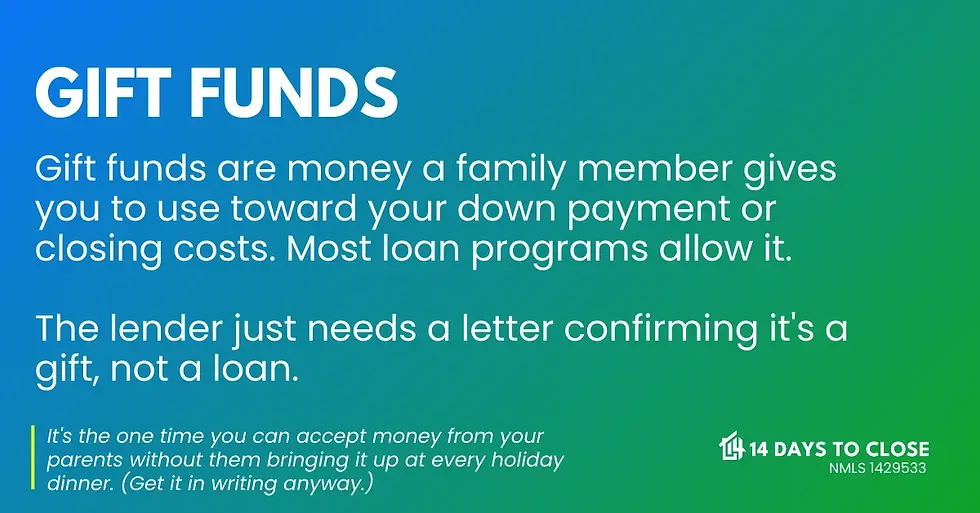
Every FHA gift must be accompanied by a gift letter. The letter needs to include the donor's name, address, and phone number; their relationship to you; the dollar amount; the address of the property being purchased; and a statement that the money is a gift and not a loan that has to be repaid.
That last sentence is critical. If the gift letter doesn't clearly state that repayment is not expected and not required, the underwriter will treat the funds as a loan — which changes your debt-to-income ratio and could affect your approval.
How the Gift Funds Need to Be Documented
FHA requires that the transfer of gift funds be documented. Typically, this means providing the donor's bank statement showing the funds leaving their account and a statement from your account showing the funds arriving. If the donor is writing a check at the closing table, the check and evidence of it clearing may be sufficient.
We underwriters look at this closely. If there's a large deposit in your account that isn't explained, it gets flagged. If the gift came in a month before closing and has already seasoned in your account, it may not need the same documentation — but lenders differ on this. The safest approach is to keep a clear paper trail from the moment the conversation starts.
Common Gift Fund Mistakes That Kill Deals
The most frequent problem is the gift being structured as a loan. If the donor mentions repayment — even casually, in a text message that surfaces later — the underwriter has grounds to reclassify it. The gift letter needs to say no repayment in clear terms, and both parties need to understand that.
Another issue is cash gifts. If a family member hands you cash and you deposit it, you now have an undocumented deposit. Lenders can't verify the source, which means they can't count it. Gift funds need to move through documented bank channels.
The third issue is timing. Getting gift funds in the week before closing when the file is already in underwriting creates a scramble for documentation. If you know a gift is coming, the earlier it moves the better.
What Lenders Look for Beyond the Letter
A signed gift letter clears one hurdle, but underwriters also look at whether the gift is plausible. A retired parent gifting $50,000 should have a bank statement that supports that. If the donor's statement shows a $50,000 deposit two days before they sent the money to you, someone's going to ask questions about where that came from.
We're not trying to kill the vibe, we promise. It's about anti-money laundering requirements that lenders are legally obligated to follow. The documentation process exists to show that the funds came from a legitimate source.
Gift Funds and Closing Costs
Gift funds can cover closing costs on an FHA loan as well, not just the down payment. If a family member wants to contribute and you're already at the 3.5% minimum down payment, having them cover a portion of the closing costs is another option. The same documentation rules apply. Remember, gift letter, paper trail, and no repayment language.
Using Gift Funds the Right Way
Having a family member contribute to your down payment is a legitimate and common path to homeownership. The documentation requirements exist to protect both you and the lender. If you go in with the right paperwork from the start, gift funds rarely cause problems.
If you're planning to use gift funds on your FHA purchase and want to make sure the file is structured correctly from the beginning, reach out before you're in contract. The earlier we look at the documentation, the fewer surprises at closing.